
Change clothes and step outside. In Dressed Like Blasphemy, that is enough for a small act of rebellion: the city is used to reading a woman’s body, putting a price on it and claiming it as its own. Black fabric interrupts that reading. For the first time, the protagonist can walk past other people’s hunger without being recognised. What is strange about this SURVIVORIA song is how modest her longed-for miracle turns out to be: a few minutes in which nobody looks at her as though she were a sign put up for public inspection.
The website presents Dressed Like Blasphemy as a standalone single from The Relay Epoch. The official video description places it within the Aurelia strand of the story and explicitly describes beauty as a form of counter-surveillance. That is a useful starting point: the dress does practical work here, covering what everyone else has grown used to treating as their property.
Who Owns What Can Be Seen
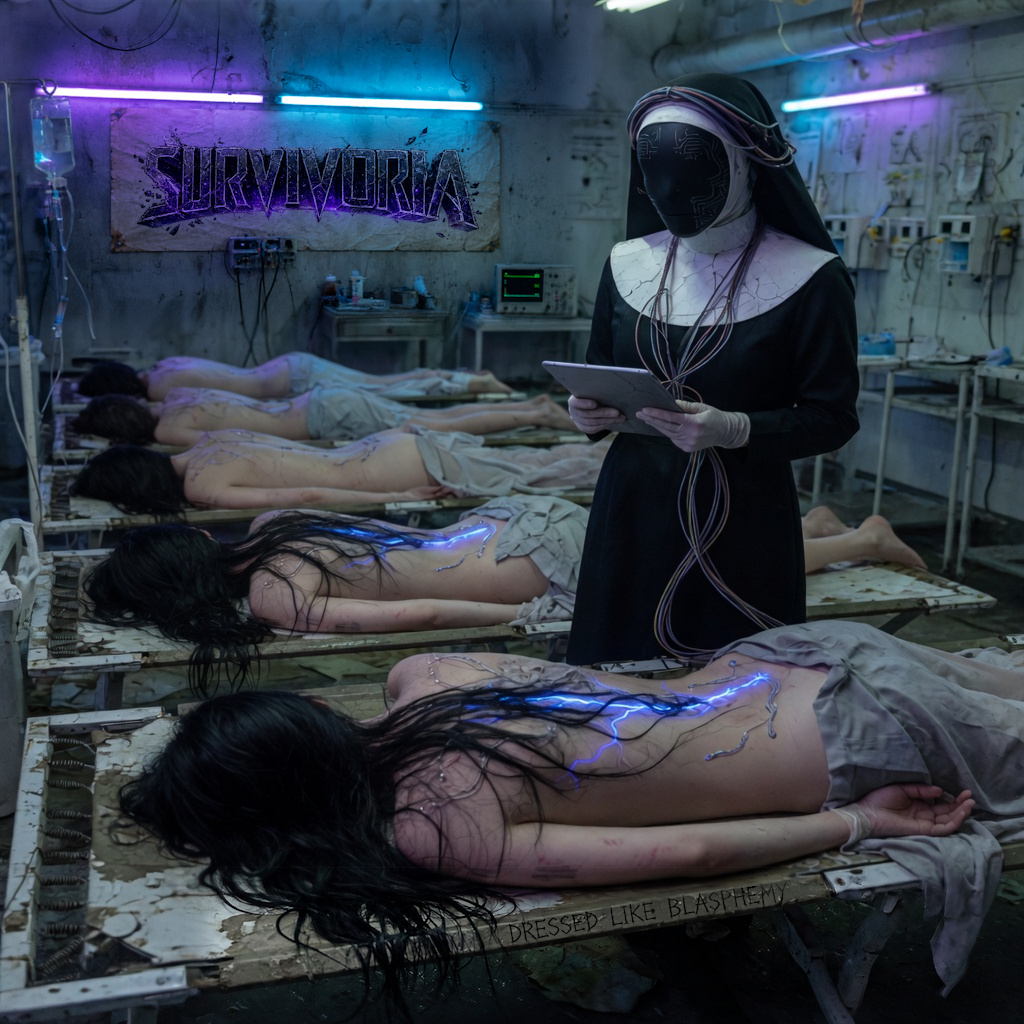
The cover reveals the other side of this story. A figure in a nun’s habit holds a tablet beside rows of reclining bodies, blue light tracing their skin. The religious silhouette stands in what looks like a medical facility. The image can be read as a scene of inventory-taking: the bodies are exposed to inspection, while the observer’s face remains hidden. Some must be visible; another is allowed to remain faceless. The distribution of gazes already tells us something about power.
Against this backdrop, Dressed Like Blasphemy becomes more than a striking Gothic phrase. If the body is required to serve as public testimony, covering it looks like a breach of ritual. The lyrics bring urban surveillance, religious language and clothing into close proximity. Together, they turn an ordinary gesture—adjusting a sleeve, checking the fabric—into a possible attempt to reclaim the boundary between the private and the public.
The Price of a Sleeve
The fabric, however, keeps an account of its own. In the published lyrics, beauty is paid for in blood, memory and the self. The list returns, and each return makes it harder to mistake relief for a final victory. The protagonist understands the terms of the bargain. That makes her wish to keep the dress easier to understand: even a dangerous reprieve is still a reprieve when no other protection is at hand.
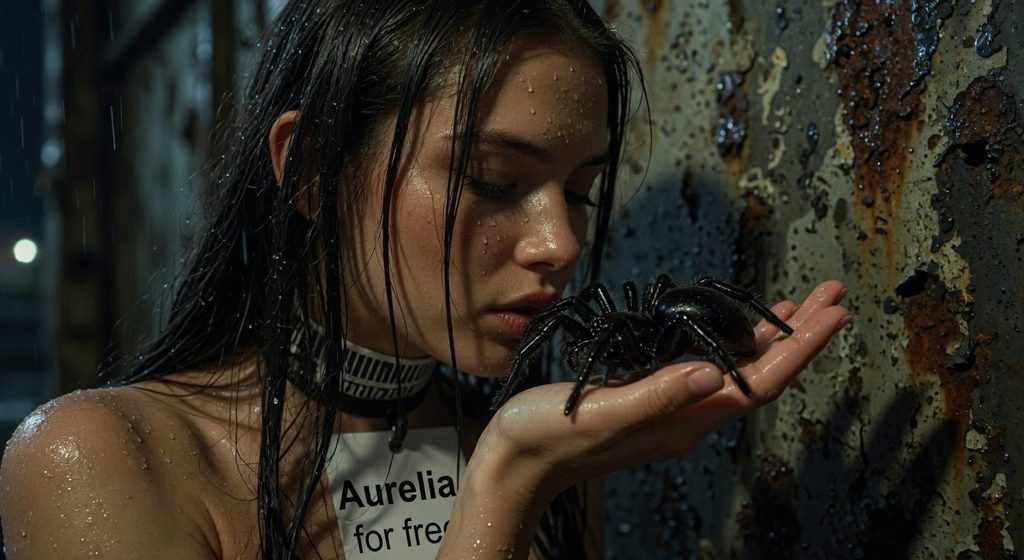
The player’s illustration brings this ambiguity almost uncomfortably close: a large black spider rests on a palm held beside a face. There is no safe distance between vulnerability and threat. The image can be read alongside the intimate, dangerous relationship between the protagonist and her shelter; it does not, by itself, explain exactly where the dress came from.
By the end, the dress has become an agent in its own right: it is now wearing her. That reversal gathers the story into a single image. The protection against public possession begins to possess the person it protects. Yet the moment in which she gets to feel like a woman rather than a warning sign does not lose its value in retrospect. It still measures what the city has taken from her.
This track is a dark, aggressive industrial techno piece that fuses the relentless four-on-the-floor drive of classic techno with the abrasive, machine-like textures of industrial music. The production is built around a pounding, distorted kick drum that anchors the rhythm, while a deep, gritty synth bass provides a rumbling low-end foundation. Layered atop this are harsh, metallic synth stabs, evolving noise textures, and heavily processed percussive elements that create a dense, immersive stereo field. The mix is deliberately raw and high-fidelity, emphasizing aggressive compression and saturated distortion to keep every element cutting through the wall of sound.
Vocals are delivered by a female performer in a mid-range register, but they are transformed into a robotic, distorted timbre through extreme processing. The delivery is spoken-word/chanting, rhythmic and almost monotone, with heavy distortion, vocoder-style filtering, reverb, delay, and pitch-shifting that render the voice as another synthetic instrument rather than a traditional melodic line.
Structurally, the composition follows a typical electronic-dance framework: an atmospheric intro introduces the distorted kick and bass, building tension with layered synth noise before dropping into the first vocal-driven section. Subsequent verses alternate between spoken-word passages and instrumental breaks that heighten intensity through additional distortion and filter sweeps. A recurring chorus-like segment brings the central lyrical hook to the forefront, followed by a breakdown where the beat momentarily recedes, allowing the processed vocals to dominate before the full rhythm crashes back in for a final, relentless climax. The dynamics remain consistently high, with each section escalating the sense of urgency and aggression.
Overall, the track exudes a cold, mechanistic mood that situates it firmly within the contemporary industrial-techno scene, echoing the aesthetic of early-2020s underground clubs where harsh sound design and dystopian lyricism intersect to create a visceral, immersive experience.
Dressed Like Blasphemy rests on that uncomfortable remainder. Shelter does not erase the brand, and its price does not make the need for shelter any less real. The song leaves us with a disarmingly ordinary question about clothing: how much of yourself must you give up just to walk down the street?

